What is the Point of Therapy?
"Human effort and understanding are important, but they can only take us so far. The deepest healing requires something more."

There has been much talk in our culture recently about whether therapy is actually helpful or beneficial for society.
I think this is a good question to ask.
What exactly is the point of therapy? What is it supposed to accomplish, and does it really help people?
One of the most important realizations I have come to is that the goal of accompaniment is not simply symptom reduction, but peace.
These two things can look similar, but they are not the same. Relief from symptoms is often a good and necessary thing. We want people to feel less anxious, less depressed, less overwhelmed, and less trapped by the things they are struggling with. But I don't think that is the deepest aim.
True peace goes beyond simply feeling better. It touches the whole person. It leads toward greater freedom, greater integration, and ultimately, a deeper communion with God.
So this raises an important question: How does this kind of peace actually come about?
Bringing What Is Hidden Into the Light
St. John Paul II offered an insight that has become increasingly meaningful to me. He wrote that:
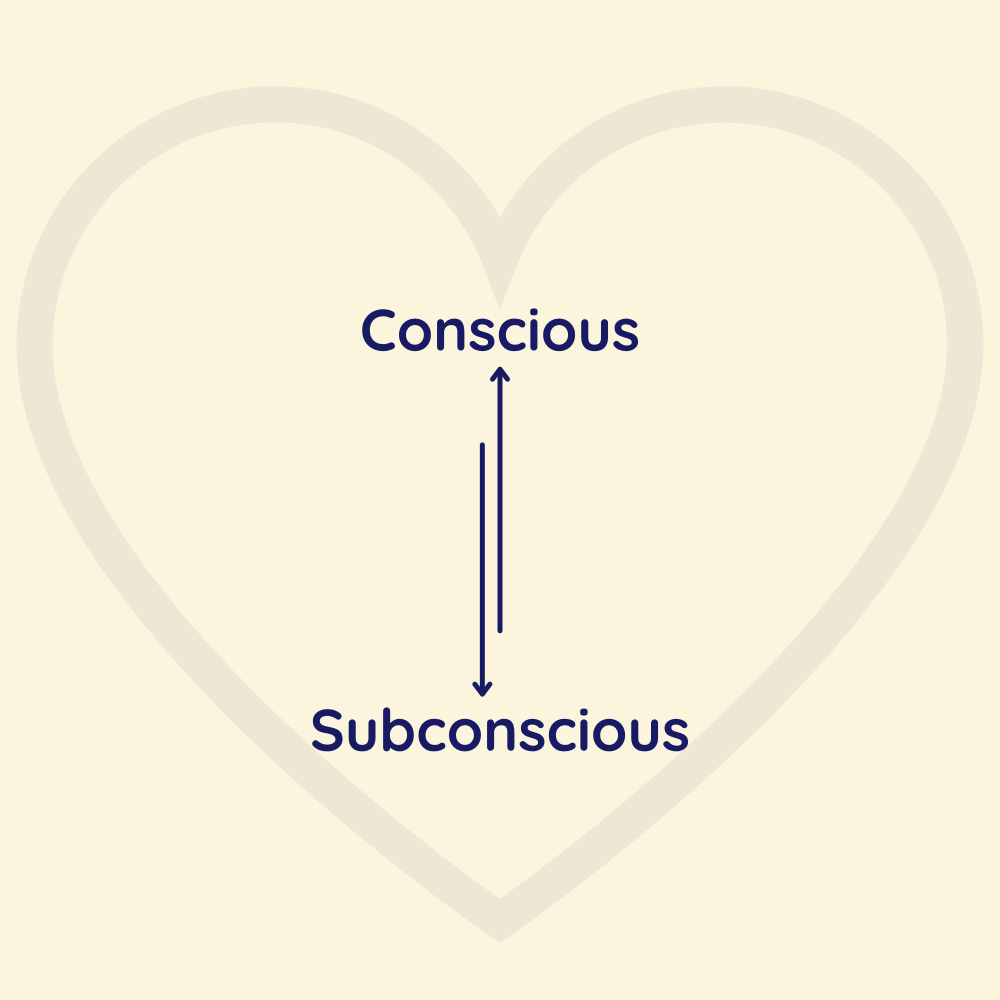
“One of the chief tasks of morality and education is to release into consciousness those genuinely human moments that may be held captive in the subconscious.”
There is something profound in this idea. There is much more going on within us than what we are consciously aware of. In many ways, our conscious awareness is only the tip of the iceberg.
This became especially clear to me through parts work, particularly Internal Family Systems (IFS), with its understanding of protector parts, exile parts, and what St. Paul refers to as the “innermost self.”

Protector parts work hard to keep painful experiences and emotions out of our awareness because they believe that what has been pushed away might overwhelm us. Exile parts, on the other hand, are the wounded parts of ourselves that carry painful emotions, memories, and experiences.
What has struck me is that these wounded parts don't necessarily want to remain hidden. Deep down, they want to be known. They want to be loved. They want to belong.
Understanding this has changed the way I think about the inner life.
I have become much less inclined to see resistance as evidence that someone doesn't want to heal. Often, resistance is a protective response. A part of us may be afraid that if we allow something painful into awareness, we will be overwhelmed by it again.
In that sense, the resistance itself often makes sense.
Rather than trying to force our way past these protections, we can become curious about them. We can begin to understand what they are protecting and why. Over time, this can create a way for what has been hidden to come into the light and be met with compassion rather than fear.
Where Psychology Meets the Spiritual Life
This movement from darkness into light is not only a psychological idea. It also has a deeply spiritual dimension.
There is a phrase that has always resonated with me, even though it may sound a little cliché:
“God writes straight with crooked lines.”
I think there is a lot of truth in that.
God works through the imperfections, wounds, failures, and disorder of our lives. What lies hidden within us—our fears, wounds, failures, and even unrealized potential—is not meant to remain buried forever. It is meant to be transformed.
Human effort and understanding are important, but they can only take us so far. The deepest healing requires something more. It requires openness to God.
Even our movement toward God begins with grace. When we cooperate with that grace, however imperfectly, God begins His work of redemption. He takes what has been distorted by sin, suffering, and broken relationships and slowly begins to transform it into something beautiful.
This transformation is rarely immediate.
The Formation of Our Protective Parts
The story of how these exiled parts develop begins very early.
Even as infants and young children, we quickly learn ways of managing fear, discomfort, and vulnerability. When something feels overwhelming, we instinctively look for ways to protect ourselves.
At that age, we don't yet have the capacity to understand or regulate many of the experiences we encounter. So we develop ways of coping. These strategies can be incredibly adaptive and even necessary when we are young. The problem is that what helped us survive or cope at one stage of life may not continue to serve us as well later on.
Over time, painful emotions, memories, and unmet needs can be pushed out of conscious awareness. But what is hidden doesn't simply disappear. It can continue to shape our thoughts, emotions, relationships, and behaviors beneath the surface.
We can find ourselves reacting to something in the present with an intensity that seems difficult to explain. Sometimes what we are responding to in the present is connected to something much older that has never really been brought into the light.
This push and pull can continue throughout our lives. Parts of us long to be seen and known, while other parts work hard to keep those same things hidden.
Much of this happens outside our conscious awareness.
Learning to Accompany Rather Than Fix
Holding this perspective has profoundly changed the way I accompany people.
I have become less focused on fixing and more focused on being present.
Beneath every defense is a story. Beneath every protector is often a wound. And beneath every wound is a person who longs to be seen, known, and loved.
Therapy, then, is not simply about getting rid of symptoms or making difficult emotions disappear. It can be a process of bringing what has been hidden into the light, allowing what has been wounded to be known, and gradually becoming more integrated and free.
And beneath all of this is the quiet work of grace.
God is continually drawing light out of darkness and bringing hidden beauty into the open.
Perhaps that is closer to the point of therapy—not simply that we feel better, but that we become more fully ourselves, more free to love, and more open to the God who has been present in all of it.

Email Sign Up:


Interested in meeting?
Fill out a contact form to request an appointment with one of our therapists.