One of the most common problems I come across in therapy is the anxiety loop.
Anxiety can be a pesky daily companion. It can wear down your nervous system, keep your mind spinning, and make it hard to be present in your life or relationships. People often describe it as feeling like their mind gets stuck on something and just keeps circling around it. I hear the word 'spiraling' a lot when people are describing it.
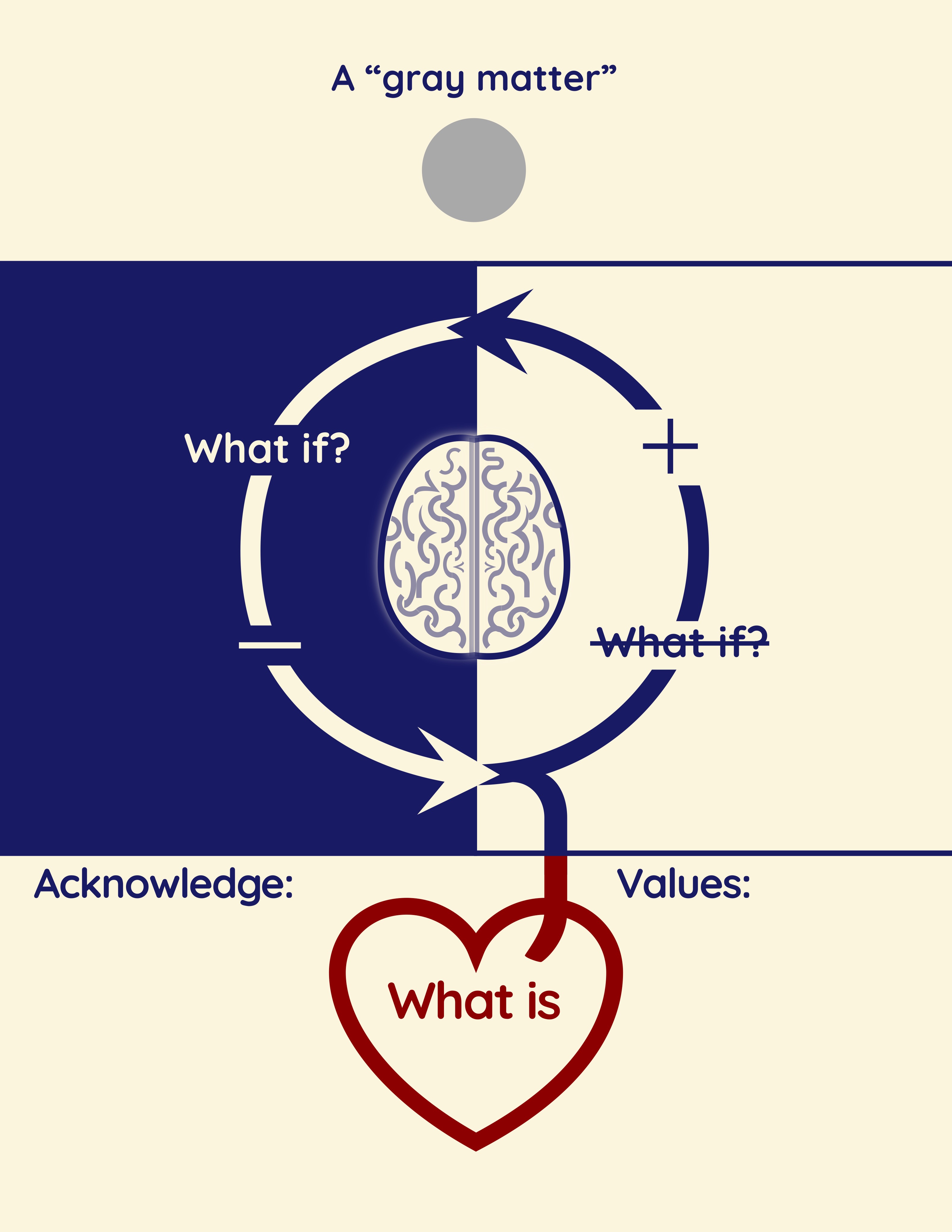
Because it is so common and so frustrating, I decided to create an anxiety loop diagram using Insight Anchors. The goal is to give clients a simple way to map what is happening in their mind and nervous system—and then begin to see how to exit from the anxiety loop.
Here is the visual I often use to guide that intervention.
The “Gray Matter” Problem
When anxiety first starts, it usually begins in what I sometimes jokingly call the “gray matter.” It's a situation in life that we can't have 100% certainty about. Like the future being okay. Social acceptance/approval. Whether or not we have hurt someone. To what extent my intention was "pure" or my emotion "genuine." The quality of the emotional bond with my spouse.
Your brain (gray matter) starts asking questions about this gray matter.
Often they take the form of “What if…?”
- What if something goes wrong?
- What if I made a mistake?
- What if they think something bad about me?
- What if I can't handle what’s coming?
- What if they reject me?
In other words, the mind starts running hypothetical scenarios.
Now, the interesting thing is that the mind actually thinks it is helping when it does this. From an "animal nature" perspective, the brain’s job is to scan for danger and prepare for problems.
At first the loop can feel like problem-solving. This can feel satisfying, like scratching an itch. But it can end up feeling terrible, agonizing even. Take the case of scrupulosity. Giving in to scrupulous doubt can feel like you're being morally responsible, but it consumes more and more mental and emotional energy.
In any case, the questions are not productive because they become circular.
Instead of solving anything, the brain keeps spinning the same possibilities over and over.
The Four Points of the Anxiety Loop
One detail in the diagram that is easy to overlook is the plus and minus signs inside the loop.
Those are there to show that anxiety loops are not just mental—they are emotional reinforcement cycles happening in the nervous system. You may immediately say - i don't have any positive emotions with my loop - so this must not apply. But the plus sign does not necessarily mean happy feelings.
There are really four spots in the loop.
- The “What if?” thought
- The spike of negative emotion
- The attempted solution or ritual
- The emotional payoff
Let’s walk through those.
1. The “What if?” Thought
The loop starts with the brain making sense of possibility.
A question pops into your mind:
- What if something bad happens?
- What if I made a mistake?
- What if they are upset with me?
These thoughts are not necessarily irrational. In fact, they often start as reasonable questions about uncertainty.
But the brain begins to treat them as urgent problems that must be solved immediately.
2. The Negative Emotion Spike (−)
Right after the “what if” thought, there is usually a spike of emotion.
This is what the minus sign in the diagram represents.
The emotion might be:
- fear
- dread
- shame
- disgust
- vulnerability
- helplessness
- uncertainty
The key thing is that the emotional reaction is bigger than the situation actually requires.
Almost as if the nervous system treats the thought as if it were a real threat.
At that moment the brain says something like:
“This feeling is bad. We need to fix it.”
And that urgency drives the next step, often at a lightning fast pace....so that you aren't even aware of the emotions spike.
3. The Attempted Solution
Next comes the attempted solution.
This might be:
- rumination
- reassurance seeking (or starting a fight with someone for attention)
- checking
- researching
- mentally replaying events
- avoidance
- trying to “figure it out” one more time
In obsessive anxiety this step can become very elaborate.
But the purpose is always the same:
to bring down the negative emotion spike.
4. The Emotional Payoff (+)
This is where the plus sign comes in (representing what makes your brain "happy", even if it makes you sad).
After the attempted solution, the nervous system experiences a shift.
It might not feel like happiness exactly, but something changes.
For example:
- relief
- reassurance
- a sense of control
- anger (power to offset vulnerable feelings that were triggered by the what if)
- a sense of mastery
- temporary calm
- the feeling of “okay, now I understand”
- a black and white answer in the affirmative or the negative can lead to certainty, even if the emotion that tiggers is despair.
Even if the relief only lasts a few seconds, the brain notices it.
From the brain’s perspective, the sequence looks like this:
Thought → Distress → Ritual (worry or action)→ Relief
And the brain concludes:
“That felt satisfying. Let’s do that again.”
This is how the loop becomes a habit circuit.
A Quick Note on the Brain Science
Different forms of anxiety involve slightly different brain circuits, but a common pattern involves:
- The amygdala detecting threat
- The insula generating feelings of distress or unease
- The anterior cingulate cortex signaling that something is wrong
- The prefrontal cortex trying to solve the problem
When the brain performs a behavior that reduces distress—even temporarily—the dopamine learning system tags that behavior as useful.
So the brain strengthens the pattern.
Over time it becomes almost automatic.
Your brain has learned:
“When distress happens, this is what we do.”
Why Exposure Therapy Helps
This is also why exposure-based therapy can be so powerful.
The goal is not to eliminate the “what if” thoughts.
Those will still occur.
Instead, exposure therapy gradually helps reduce the size of the negative emotion spike.
When the emotional surge becomes smaller, something important becomes possible.
You can notice the thought without being pulled into the compulsive response.
In approaches like:
- Exposure and Response Prevention (ERP)
- desensitization hierarchies
- other exposure-based protocols
the client practices allowing the thought and the emotional spike to exist without performing the ritual or attempted solution.
Over time the nervous system learns:
“This feeling is uncomfortable, but it is not dangerous.”
And the loop begins to weaken.
How Exposure without Ritual leads you from Head to Heart
When the anxiety loop quiets down, something else becomes possible.
Instead of living in the endless cycle of “what if?”, a person can begin to turn toward the deeper question in the diagram:
“What is?”
Often underneath the loop there are real emotions waiting to be acknowledged.
Things like:
- sadness
- grief
- loneliness
- anger
- vulnerability
- past wounds
These emotions are often very different from the manufactured distress inside the anxiety loop.
But the loop keeps people too busy trying to solve imaginary problems to notice what is actually present.
Once the habit loop loosens, the deeper emotional work can begin.
That is the place where real healing tends to happen. The mind was trying to solve a problem, but the heart was actually asking for something else—acknowledgment.
The Role of Values
The other piece in the diagram is values.
Once we move from endless speculation (“What if?”) toward reality (“What is?”), we can begin asking another helpful question:
What kind of person do I want to be in this situation?
That question shifts the focus from controlling uncertainty to living according to values.
Instead of trying to eliminate anxiety completely, the goal becomes:
- noticing what is happening
- grounding in reality
- choosing a response that aligns with who you want to be
- trusting in God's providence and care for you no matter what
This is where many therapeutic approaches converge—whether it’s ACT (acceptance and commitment therapy), REBT (rational emotive behavior therapy), or other forms of emotional processing.
The shift is subtle but powerful.
The mind stops trying to out-think uncertainty, and instead starts moving toward meaningful action.
Mapping Your Own Anxiety Loop
If you struggle with anxiety, it can be surprisingly helpful to map out your own loop.
You might ask yourself:
- What situations trigger my “what if” thinking?
- What kinds of scenarios does my mind tend to imagine?
- What emotions show up in my body during those moments? Not the ones that go with your ritual response, but the ones that immediately follow or go with the "what if" scenario.
- What is the deeper feeling that may be underneath the anxiety? Feelings I have about the "gray matter" situation in life that my heart is facing.
- What values would guide my response instead of the loop?
Simply seeing the pattern can already loosen its grip.
Anxiety thrives when it feels mysterious and uncontrollable.
But when you can map the loop, you begin to see where the cycle starts—and where it can be interrupted.
Email Sign Up:


Interested in meeting?
Fill out a contact form to request an appointment with one of our therapists.